
Gold and silver prices have been climbing steadily, marked less by speculative spikes and more by persistent, incremental gains. Volatility has remained contained, pullbacks shallow, and price strength has endured even during periods when higher real yields or tighter financial conditions would traditionally pressure precious metals.
Silver, while structurally more volatile, has followed the same directional trend. Its price behavior reflects not only industrial demand but also tightening physical supply conditions within the broader precious metals complex.
This pattern suggests the presence of structural demand rather than sentiment-driven inflows. A key contributor lies in banking regulation — specifically Basel III Endgame — and how it has altered balance-sheet incentives across the financial system.
Basel III Endgame and the Changing Economics of Gold Ownership
Basel III Endgame represents the final phase of post–Global Financial Crisis reforms, designed to strengthen bank capital quality, reduce leverage, and improve resilience under stress scenarios. One of its more consequential features is the regulatory treatment of physical, allocated gold.
Under Basel III Endgame, allocated physical gold is recognized as a Tier-1 asset, valued at 100% of its market value for capital adequacy purposes. This places physical gold alongside cash and high-quality sovereign bonds in terms of balance-sheet quality.
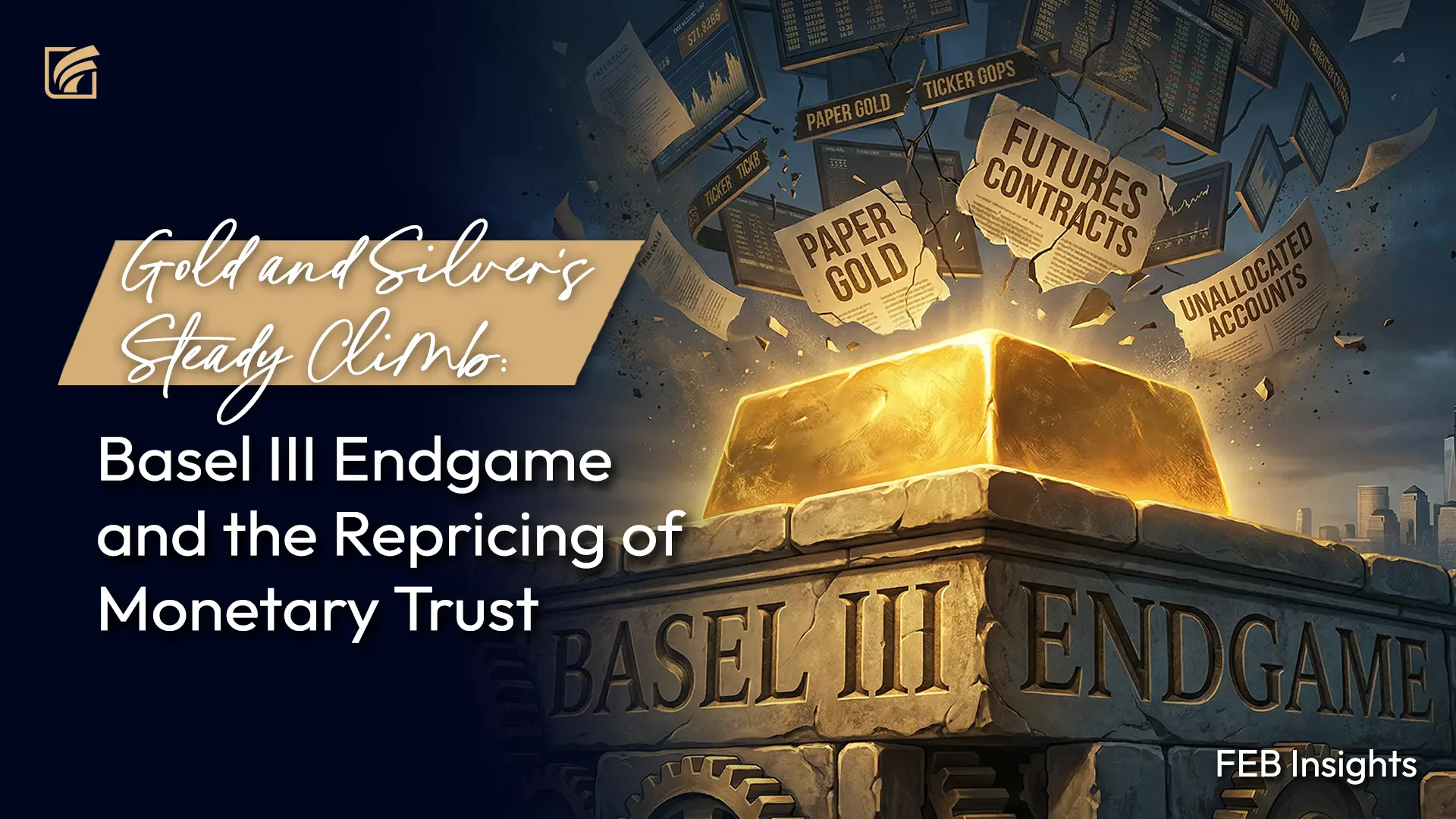
Crucially, this favorable treatment does not extend to “paper gold.” Gold-backed ETFs, futures contracts, unallocated accounts, and other derivative exposures do not qualify for the same regulatory recognition. Under liquidity and funding rules — particularly the Net Stable Funding Ratio (NSFR) — these instruments may carry higher funding requirements or receive less efficient treatment than allocated physical bullion.
The distinction is technical but impactful:
- Allocated physical gold improves capital and liquidity ratios
- Paper gold does not receive 0% risk weighting or HQLA recognition
- Banks must hold more capital or stable funding against synthetic gold exposure
Basel III Endgame does not prohibit paper gold. Instead, it raises the balance-sheet cost of holding it relative to physical ownership. Over time, this shifts institutional preference without the need for explicit restrictions.
From Paper Dominance to Physical Constraints
For decades, gold pricing was dominated by paper instruments, where trading volume far exceeded available physical supply. This structure enabled deep liquidity but diluted the role of physical scarcity in price formation.
As Basel III Endgame increases the regulatory cost of unallocated exposure, the economics of this model change. Banks adjusting balance sheets to meet capital and funding requirements are incentivized to reduce synthetic exposure and increase allocations to physically settled gold.
Observable outcomes include:
- Increased demand for allocated gold and physical vaulting
- Reduced reliance on unallocated gold accounts
- Greater sensitivity of prices to physical inventory levels
This shift helps explain why gold prices have risen steadily without the leverage-driven volatility typical of previous cycles. Price support increasingly reflects institutional balance-sheet behavior rather than speculative trading activity.
Silver, while not designated a Tier-1 asset, is indirectly affected. With thinner inventories and less depth in paper markets, changes in gold’s market structure tend to transmit into silver prices with greater amplitude.
Gold and Bitcoin: Parallel Narratives, Distinct System Roles
Gold’s renewed prominence has revived comparisons with Bitcoin, particularly around their shared positioning as alternatives to fiat money. Yet their roles within the financial system remain structurally different.
Gold’s current strength is rooted in institutional integration:
- Embedded within regulatory capital frameworks
- Held by central banks and commercial banks
- Fully compatible with existing financial infrastructure
Bitcoin remains system-external:
- Fixed supply enforced by protocol
- Independent of bank balance sheets
- Outside formal reserve and capital treatment
Basel III Endgame reinforces gold’s position within the regulated financial core while remaining neutral toward Bitcoin. As a result, gold tends to benefit from regulatory tightening and balance-sheet realignment, while Bitcoin remains more sensitive to liquidity conditions and risk sentiment.
This reflects functional separation rather than direct competition.
Diversification, Not Substitution
The evolving monetary landscape points toward layering rather than replacement.
- Fiat currencies retain transactional dominance but face credibility constraints
- Gold functions as a regulatory and balance-sheet anchor
- Bitcoin operates as a parallel monetary system outside institutional frameworks
Basel III Endgame accelerates this separation by embedding physical gold more deeply into the financial system, while digital assets remain structurally external.
The result is a fragmented but interdependent architecture in which different assets absorb different forms of stress — regulatory, monetary, and institutional.
Closing Observation
Gold and silver’s steady climb reflects regulatory architecture reaching maturity rather than speculative excess. Basel III Endgame has altered how banks assess capital quality and liquidity, making physical gold structurally more attractive than synthetic exposure.
Silver has followed through proximity to gold’s market structure, while Bitcoin continues to evolve along a separate axis defined by technology rather than regulation.
Together, these dynamics suggest that money is being quietly repriced — not through abrupt regime change, but through incremental shifts in how the financial system defines safety, settlement, and trust.