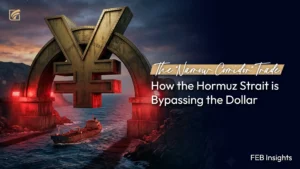
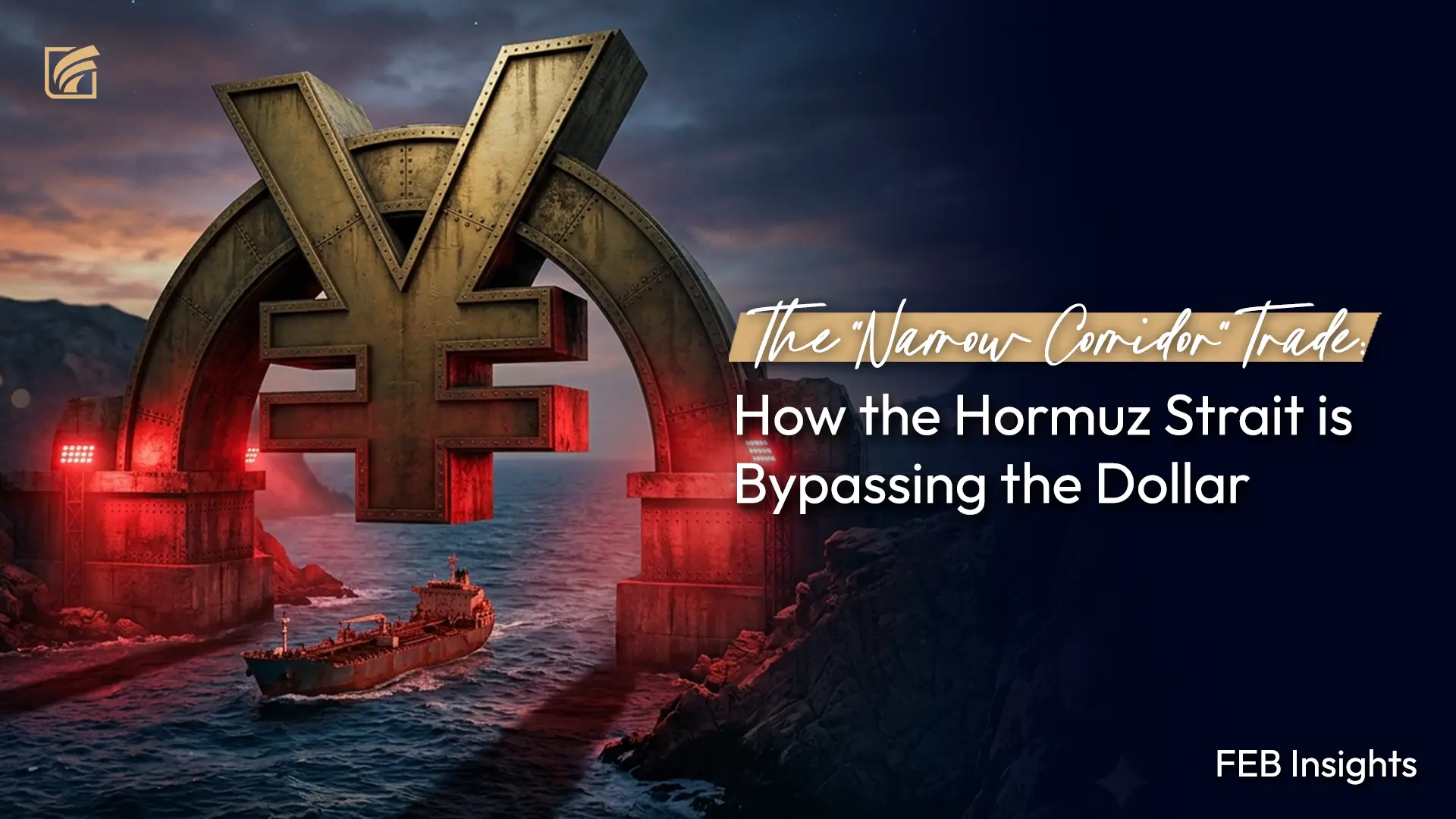
When analysts talk about “de-dollarization,” they usually point to BRICS summits or central bankers discussing gold reserves. But to understand where the global financial system is actually heading, it’s more useful to watch trade chokepoints than podium speeches.
Over the past month, attention has shifted to the Strait of Hormuz — a reminder that de-dollarization is no longer theoretical but increasingly transactional. What was once discussed in terms of policy statements and reserve diversification is now appearing in how energy is priced, settled, and financed. The shift is subtle, but meaningful: currency choice is beginning to follow trade flows rather than tradition. The result is an early but visible reshaping of the global liquidity map.
1. The “Yuan or No Passage” Variable
Recent escalations involving Iran have introduced a powerful economic lever: currency denial.
Reports from the region indicate that energy corridor access is increasingly conditioned on settlement in currencies other than the USD, specifically the Chinese Yuan. Iran is not just exporting oil; it is exporting a currency requirement.
Historically, the Petrodollar system worked on a simple understanding: oil would be priced and settled in dollars, supported by a US-backed security umbrella protecting shipping lanes. That security premium is now in question. When a nation influencing a chokepoint — through which roughly 20% of global oil supply transits — signals preference for Yuan-denominated settlement, it begins to weaken the psychological foundation of the petrodollar framework.
2. De-dollarization at the Chokepoints
Most discussions on de-dollarization focus on politics or ideology. Here is the nuance most articles miss: this isn’t “Anti-Americanism”; it’s logistics shaped by trade routes and access conditions.
Energy importers generally have two settlement options:
The Traditional Route: Dollar payments via US-linked banks over SWIFT remain the standard for cross-border trade. Settlement follows the US dollar and relies on correspondent banking networks, which can be affected by sanctions or access restrictions in volatile geopolitical environments.
The Alternative Route: Systems like China’s Cross-Border Interbank Payment System (CIPS) allow settlement in currencies such as the Chinese yuan. Operating under a different clearing framework, these systems provide an option when trade routes or geopolitical conditions make traditional dollar channels less accessible.
Recent tensions around key trade chokepoints, including the Strait of Hormuz, are increasingly conditioning access on non-dollar settlement. In effect, these chokepoint-driven constraints are shaping which currencies are used for trade. The dollar is being bypassed because physical trade routes create a “narrow corridor” that favors alternative settlement methods, a phenomenon we can describe as chokepoint-driven de-dollarization.
3. Multi-Currency Settlement Infrastructure
The infrastructure enabling this shift is not a new reserve currency, but new settlement rails.
Central Bank Digital Currency (CBDC) experiments and multi-currency ledgers are increasingly designed for direct cross-border settlement without traditional correspondent banking layers. One example is Project mBridge, a multi-central-bank initiative involving monetary authorities across Asia and the Middle East.
These platforms allow near-instant atomic settlement — where payment in one currency and receipt in another occur simultaneously. This removes the need for an intermediary balance held in New York or London during the settlement window.
This is effectively a SWIFT-bypass mechanism. It does not require the dollar to weaken. It only requires alternative rails to be faster, cheaper, or less exposed to geopolitical risk.
In high-conflict environments, speed becomes a form of financial safety. If assets may be frozen or payments delayed, market participants will favor systems that reduce settlement risk — even if that means shifting currencies.
4. Implications for Your Wallet
So, what does this mean for you — as someone making payments, managing currency exposure, or engaging in cross-border trade?
The Fragmentation of Liquidity
The dominance of the US dollar in global trade is no longer absolute. You may increasingly encounter situations where certain goods or services require payment in non-dollar currencies, such as the Chinese yuan or regional currencies tied to key chokepoints. Holding or accessing multiple currencies may become necessary to navigate trade and payment networks efficiently.
Rethinking Safe-Haven Assets
Traditionally, the dollar has been viewed as a go-to safe asset during periods of global instability. However, the current situation is unusual because the source of instability — tensions between the US/NATO and regional powers — comes from the same country that issues the dominant global currency. We are seeing a decoupling where gold and, surprisingly, Bitcoin are being viewed as “neutral” settlement layers.
Transaction Costs and Planning
As settlement shifts beyond the dollar, conversion costs and access to different currencies can vary depending on trade routes and chokepoints. Being aware of alternative settlement pathways and planning for multi-currency transactions can help reduce costs and mitigate route-specific risks.
5. The Verdict
The dollar isn’t collapsing. The US financial system remains the deepest pool of capital in the world.
Yet the monopoly over global payment channels is no longer absolute. The US financial grid (SWIFT/CHIPS) has proven itself a weaponizable utility, capable of shaping cross-border settlements and trade flows. Meanwhile, the yuan and other emerging alternatives have prompted the creation of parallel settlement networks, gradually forming a multi-grid, multi-currency system.
The future isn’t about choosing between the dollar and the yuan. It’s about navigating the Old Grid and the New Grid seamlessly across currencies and payment infrastructures — a reality where flexibility, speed, and resilience determine who thrives in global trade.
Disclaimer
This article is for informational purposes only and does not constitute financial, investment, legal, or other professional advice. The views expressed are neutral and reflective of currently available data as of the publication date. Readers should consult qualified professionals before making decisions based on this information.